Analyzing the Core Workflow of the Belt-Type Fully Automatic Screen Changer
The Zhengzhou Batte Belt-Type Fully Automatic Screen Changer is a continuous production equipment designed for melt filtration. Its core function is to precisely remove impurities such as carbonized particles and metal shavings from molten materials while ensuring stable melt pressure and flow rate, thereby achieving zero production downtime. Its operational principle relies on the coordinated operation of automated control and physical mechanisms. The core process can be divided into five key stages: trigger activation, heating-assisted migration, mesh belt transmission, cooling sealing, and cycle standby. Details are as follows:
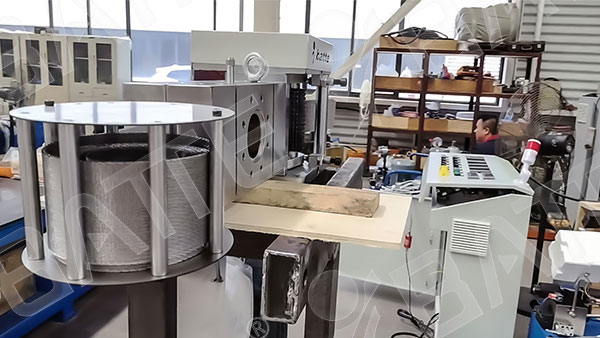
Trigger Activation
The screen change program is initiated through an automatic detection mechanism, with core trigger conditions falling into two categories: pressure-triggered activation occurs when melt pressure at the feed inlet rises to a preset threshold (indicating screen clogging due to impurity retention); time-triggered activation occurs when the operating duration reaches a preset interval. Upon meeting either condition, the control system immediately activates the actuator to initiate the screen change process.
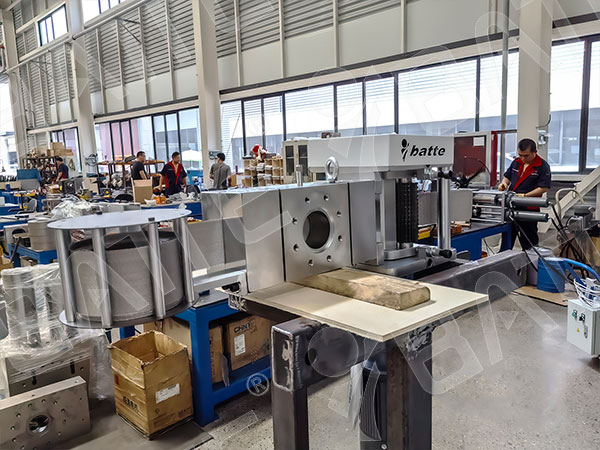
Heating-Assisted Migration and Screen Belt Drive
The control system then activates heating elements at the outlet (e.g., electric heating rods) to precisely heat localized sections of the melt channel. This reduces melt viscosity, facilitating screen belt movement. Subsequently, no external force is required—the melt's own pressure slowly propels the screen belt, simultaneously conveying surface-trapped impurities out of the filtration chamber to ensure uninterrupted material flow.
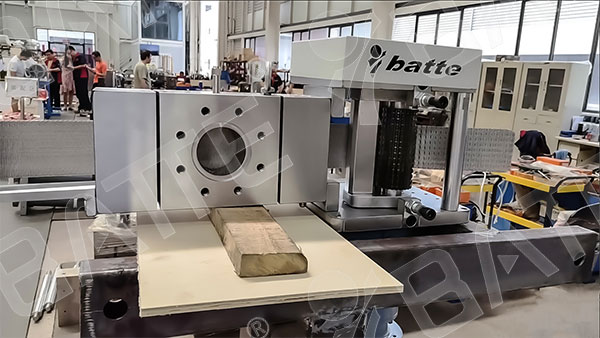
Cooling Seal and Standby Circulation
Upon the filter belt's exit from the chamber, the outlet water-cooling system activates immediately. Circulating cooling water rapidly solidifies residual melt within the channels, forming a dense seal that completely prevents melt leakage. Simultaneously, the melt pressure at the inlet drops back to normal range. The control system then halts heating and maintains the cooling state until the seal stabilizes. When conditions for the next screen change are met, the system restarts the circulation process, ensuring continuous constant-pressure production. Through precise coordination between automated control and melt pressure, this process achieves smooth transitions between continuous screen belt movement and filtration states. The entire operation maintains stable material flow and constant pressure, effectively safeguarding production continuity and product quality.
Email: sale@meltpump.com
WhatsApp: +86 158 3833 1071